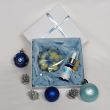
Tours, workshops, and dyeing classes with Françoise Carayol, an indigo and pastel dyer in Escoussens.
The dyeing workshop is open to visitors.
Françoise Carayol welcomes you from April through November at her workshops in Escoussens and Lautrec. Passing on this forgotten craft is close to her heart; as a true enthusiast, she’ll introduce you to her craft and the world of this mysterious blue. She offers tours of her workshops to reveal all the secrets of pastel—from the Neolithic era to the present day, from the plant to the blue, from the blue to the dye, whether it’s pastel dyeing or indigo dyeing with pastel—and she’ll answer any questions you may have.
All dyes are 100% natural, produced using traditional methods.
The workshops are open to everyone—from introductory sessions to hands-on “I’ll do the dyeing” workshops, as well as courses for amateurs and professionals.
At her studio in Escoussens, you can see her slow-reduction vats, which use fermentation—methods rarely used today because they’re demanding, requiring daily monitoring and great precision. Yet the blues produced are so deep and luminous that the extra work is well worth it.
Françoise has mastered the art of natural indigo dyeing; she shares her expertise and the entire history of Pastel with great generosity and passion.
The history of Pastel in the Land of Cocagne is a life in blue, in the heart of the Land of Cocagne—the land where life is good. The “cocagne” is a ball made from crushed Pastel leaves that are fermented, shaped by hand, and then left to dry in a rack-style dryer.
During the Renaissance, this “cocagne” was the source of our beautiful region’s wealth. Indeed, the cultivation and trade of pastel were centered in the “Golden Triangle”—Toulouse, Albi, and Carcassonne—with “gold” referring to the color of its yellow flowers and the wealth it brought to the pastel merchants, who were said to be richer than kings. It was the blue reserved for the nobility.
A magical and emblematic plant of the Land of Cocagne, the dyer’s woad (Isatis tinctoria), from ancient Greek, is the European indigo plant, used for dyeing since the Neolithic era.
People began using Pastel with fresh leaves in the Middle Ages. It took an enormous number of leaves to produce any color, and the resulting hue was very pale.
Later, it was discovered that fermenting Pastel allowed the pigments to concentrate, yielding darker blues.
The widespread introduction of tropical indigo in the 16th century made it possible to strengthen the pastel vats and produce very dark blues, thereby making the dyers’ work easier; from then on, Pastel and tropical indigo became inseparable; Pastel remained indispensable until the end of the 19th century, when the supply of tropical indigo began to dwindle.
Due to the Continental Blockade, tropical indigo could no longer be imported into the country, so Napoleon launched a production of Pastel indigo, and two indigo factories were established in Albi and Toulouse. This production of Pastel indigo was a first in France, but its low profitability meant that, once the embargo was lifted, the indigo factories were closed, and dyeing resumed using Pastel reinforced with tropical indigo.
In the mid-19th century, sodium hydrosulfite—a chemical reducing agent—was discovered; the labor-intensive “cocagne” process and its lengthy production became obsolete, and it was only at this time that the complete decline of pastel cultivation was observed.
Definition of indigo: A blue pigment extracted from all indigo plants; synthetic indigo also exists and has been widely used today since its discovery in the late 19th century.
More information
Animaux acceptés : Non
Sprache
- French
Opening
Ouverture du 01 January 2026 au 31 December 2026
Services
Equipments
- Parking nearby
This provider also offers
Escoussens